Wednesday, 18 July 2012

The principles of unbalancing....


I have become quite fascinated recently about the use of unbalancing principles in karate. It seems to me that it is an art form in itself; something that can and must be studied in isolation as well as in combination with various techniques....

Unbalancing is about disruption and control: Disrupting your opponent’s attack and seizing control of them. There is both art and science in understanding balance and unbalancing methods. It requires a scientific understanding of how the brain and body work together to enable balance combined with a sense of creativity in assessing the many ways in which your opponents balance can be disrupted.

To understand how to unbalance an opponent you first need to understand how we are able to balance in the first place. I wrote a previous post about balance called ‘martial arts – a balancing act’ where I described the three main tenets of good balance as being having a wide base of support, having a low centre of gravity and maintaining the head and spine in a vertical position.  In this article I also discussed the importance of the ears, eyes and proprioception in the maintenance of good balance. 

To unbalance an opponent then you have to disrupt at least one on the main tenets of balance: pull them out of their base of support (or reduce their base of support), raise their centre of gravity or disrupt their vertical alignment. Of course you must do all this whilst maintaining your own balance.

So how do you do it? 

Ways of disrupting the base of support:

Pushing or pulling: pushing or pulling will move someone out of their base of support but you need to know which way to push or pull. This requires some knowledge of the “eight points of off balance” which relates to stances. Look at this diagram:
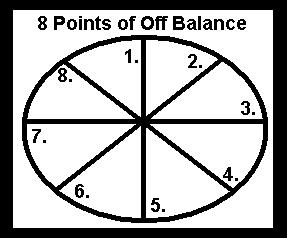


As a point of principle your off-balance point is generally perpendicular to the plane of your stance. So if your feet are positioned on points 8 and 4 on the diagram (this could be a left foot zenkutsu dachi (weight forward) or kokutsu dachi (weight back) and facing point 1 or even a shiko dachi if you were facing towards point 2 or 6) then you will be off-balance if pushed or pulled in the direction of 2 -6 or 6-2

So for example, if you are grabbed by the wrist by someone standing in front of you in a natural stance i.e with feet positioned on 3 and 7 then you only need to trap their hand and step backward to position 5 to unbalance them.  In order that you don’t unbalance yourself you need to use fairly strong, deep stances to ensure your centre of gravity remains low, your base of support is wide and your spine remains vertical. I never understand why people argue that stances in karate are no good and only useful for building leg strength – good strong stances are great for pulling people off balance. Of course taking just one step back many not be sufficient and you may need to take two or three long low steps backwards to pull your opponent over.

Reducing the opponent’s base of support: you can reduce the opponent’s base of support by taking one (or both) leg away e.g. with an ashi barai (foot sweep) technique or just a plain and simple ‘trip’. You may want to follow this up with a push, pull or even a throw.

Raising the opponent’s centre of gravity:

If a low centre of gravity assists with balance then a high centre of gravity will help reduce it. Getting your opponent up on their toes will make them seem lighter and easier to displace. Getting a good arm/elbow lock on can often get them on their toes. They won’t drop their weight back down to compensate because that will tighten the lock and cause more pain. You will now have them controlled and not fully balanced making it easier for you to apply your next technique – this may be a sweep or throw or just maintaining the restraint to march them off (always walk backwards with your restrained ‘prisoner’, I am told on good authority, it is harder for them to resist).

Disrupt your opponent’s vertical alignment:

Getting your opponent’s head and spine out of a vertical alignment will disrupt balance because it stops them from pushing their centre of gravity in a downwards direction. It is also very disorientating because it upsets the ‘balance sensors’ i.e. the eyes can no longer maintain a horizontal plane, the cochlear fluid in the ears may start to swirl and cause dizziness and the proprioceptors may have a hard time working out the body’s position in relation to the ground.

Techniques to disrupt vertical alignment include pushing the forehead backwards. This is especially effective if the other hand is placed at the lower end of the spine to create a push/pull effect. Alternatively you can twist the opponent pushing on one shoulder whilst pulling on their opposite hip.
These are just a few techniques you can use to disrupt balance, I’m sure that with a bit of creativity you can think of more!

Of course your opponent will instinctively try to correct their balance once they feel it starting to go. They will do this in predictable ways – the same ways you will try to do it. If you are pulled forward you will put a foot out to steady yourself. You will put your foot out in the direction you perceive yourself to be falling. If you are falling backwards you will try to step backwards. To stop your opponent from trying to correct their balance you need to stop them from putting their foot in that optimal position for regaining balance – you do this by making sure your foot is there first, forcing them to put their foot in a sub-optimal position and thus still being off-balance. 

To conclude: 

Unbalancing your opponent is a good tactical self-defence principle. It enables you to disrupt your opponent’s attack and gives you an opportunity to gain control of the situation. Good unbalancing is both a science and an art form. It requires some serious study into the physiological principles of balance and an exploration of ways of disrupting those principles. In any martial arts class it is worth spending time with a partner just manipulating and observing the effects of balance point disruption. Experiment with this in isolation as well as incorporating these unbalancing principles into various strategies and techniques and notice how much more quickly you are able to disrupt and control your opponent.


Sue is the Blog-Editor-In-Chief for Martial News. You can contact her at sue.wharton@martialnews.co.uk
Sue also writes a personal blog called My Journey to Black Belt


Thursday, 3 May 2012

Where does YOUR karate come from?


Don’t worry this isn’t going to be yet another treatise on the history of karate – we all know karate comes from Okinawa…

What I mean is where does YOUR karate come from in YOU?

You may be aware of the phrase Shin Gi Tai. This goes a long way to explaining where your karate comes from but in my opinion it misses one important ingredient. Before I reveal what that is lets explain what these terms mean:

Tai: This means the body (e.g. tai sabaki – body movement). It refers to the fact that to do karate well you must have a fit, healthy body that is flexible, coordinated and strong. Our body must be able to endure physical contact with another and react quickly to changing situations. We achieve this kind of body through hard repetitive training of the basics of our art as well as our own supplementary training.

Shin: This means the mind (e.g mushin – no mind; shoshin – beginner’s mind, seishin – positive mind, zanshin – an aware mind). It refers to the need to cultivate the correct mental skills to be a good karateka such as developing a clear and uncluttered mind that is fully focused on the task in hand whilst still maintaining a peripheral awareness of what is happening around. It also refers to developing a positive, confident spirit, one that will persevere with determination to achieve one’s goals.

Gi: This refers to technique. It’s no good cultivating the perfect body and mind if you don’t know how to do any karate! Obviously you need to learn and practice a range of karate techniques too.

We generally develop shin gi tai in parallel, improving in each one as we progress through training, so you might consider that your karate comes from your body, mind and good technique all combining together in a coordinated fashion . It’s a very holistic approach – the end result being greater than the sum of the parts; but for me there is an ingredient missing here…

I would argue that karate really comes from the heart. The Japanese word for this is kokora. The heart is the seat of passion, compassion, conviction not to mention courage. We feel all these things in our hearts and it is these things that drive us to be good karateka. We feel our karate in our hearts; it virtually bursts out of us if we are doing it well.

If you look around the students in your dojo you can see who has the heart for it and who doesn’t. Some will be sweating with the effort, appear to be concentrating, even have reasonable technique but their face tells you they have no heart for it, their faces expressionless and bored. Others may still be out of shape, getting a little confused with the technique but the look of joy and animation on their faces as they persist in trying to improve tell you they have heart.

Having the heart for karate may save you one day – if you lose heart you will lose the fight.

So where does YOUR karate come from – is it the heart?


Sue is the Blog-Editor-In-Chief for Martial News. You can contact her at sue.wharton@martialnews.co.uk Sue also writes a personal blog called My Journey to Black Belt
Wednesday, 28 March 2012

A beginner's mindset....

Yesterday I read a comment left on one of my recent posts on my personal blog (My Journey to Black Belt), Joint locking – how useful is it really? by an anonymous commenter, which accused me of having a ‘beginner’s mindset’. I say accused because the tone on the comment was clearly an attempt to patronise or insult me.

This is the offending part of the comment :

“…….I find this discussion rather sterile and representative of a beginner's mindset: take this question to your sensei, if he/she can't show it follow my previous advice. 

I don't mean to be condescending but from what you've written it's clear your understanding of this subject is rather limited:
 …….”

(This is just an excerpt from the comment; visit the post to read the entire comment)

At first I was a little taken back by the comment but after thinking about it for a few minutes I realised that being told I had a beginner’s mindset was in fact very high praise! It meant that I was open-minded, my cup isn’t yet full, I can still learn new things, gain new understanding….

Actually I don’t thing Anonymous meant that at all but he/she is wrong in thinking that a beginner’s mindset is a bad thing in a martial artist.

Maintaining a beginner’s mindset is a Zen concept called shoshin.  It refers to having an attitude of openness, eagerness, and lack of preconceptions when studying a subject, even when studying at an advanced level, just as a beginner in that subject would.

Zen teacher, Shunryu Suzuki said, “In the beginner's mind there are many possibilities, in the expert's mind there are few.”

There are clearly many advantages to maintaining a beginner’s mind:  curiosity, openness, enthusiasm, creativity…… Unfortunately, the person with the ‘expert mind’ becomes the opposite of this:  un-inquiring, closed mined, stilted, un-creative – arrogant even.

Clearly the concept of shoshin has spread far and wide. A quick google on ‘beginner’s mindset’ found articles promoting the concept on a range of activities including swimming, software production, yoga and advertising. Each of the experts in these fields was promoting the idea of maintaining a beginner’s mindset to improve one’s ability in the respective field of practice.

All I can say to Anonymous is thank you for noticing that I have a beginner’s mindset. Clearly I am still on the right path in my martial arts studies.

Do you have a beginner’s mindset?


Sue is the Blog-Editor-In-Chief for Martial News. You can contact her at sue.wharton@martialnews.co.uk 
Sue also writes a personal blog called My Journey to Black Belt

Friday, 2 March 2012

Age and martial arts

I was recently browsing around the Download Karate.com website and came across a video looking at students from different clubs testing for their shodan rank. The point of the video was to give you a flavour of what standard should be expected for a 1st kyu grade testing for shodan.

Here is the video:


I found the standard of the students good but also in line with what I would expect someone testing for shodan to be like. However, I was more interested in Jason Armstrong’s comments towards the end of the video where he states that in their organisation they have a different shodan curriculum for people over the age of 40 than for those under 40 (the students seen in the video are testing with the under 40 curriculum).

My first reaction to this was Hey, we’re not past it yet you know - no need to slow it down for us! Then I was reminded of my current persistent shoulder injury and the excessive aching I often get after training and realised that was my ego talking!

After thinking about it a bit more I realised that having a slightly modified syllabus for middle aged and older people is probably not a bad idea. In Jason Armstrong’s organisation the under 40 curriculum focus’s a lot more on ‘modern’ karate i.e point sparring, kata performance etc and slightly less on self-defence and bunkai. The over 40’s curriculum is balanced the other way around with more emphasis on traditional karate, self-defence and bunkai. 

I think this probably works well. In my experience younger people are better at point sparring, can get their kicks up higher and faster and often look better in the performance aspects of kata . They are often more interested in the competitive aspects of modern karate than older people.

I also think (and I’m generalising here) that older people are more interested in the technical aspects of karate and have more patience to learn and experiment with them. They tend to want to discuss technical details more and often read to assist their learning.  Of course, many younger people are like this to and many older people still like competition but as a rule of thumb  I think that younger people get more excited by the thought of sparring and putting on a good kata performance and older people get more excited about delving more deeply into bunkai and self-defence issues – it’s certainly true for me. 

I think that having different but overlapping curriculum for younger and older people can help them to play to their strengths and interests whilst still working on their weaknesses. I know some people might view this as a bit of a cop out for older people but is it reasonable to expect someone of 50 to be able to do the same physical activities as someone of 20? Anybody over the age of 40 or 50 will know that their body is not as flexible or capable as it might have been when they were younger. However, a young person cannot possible know what their body will feel like when they are older and so are in a more difficult position to make a judgement on this.

Some people would argue that everyone in a club testing for shodan should be tested on exactly the same material because that is fairer and ensures everyone achieves the same standard. This would be fair if the curriculum represents all aspects of karate equally so that older people can score more highly in areas that they are better in and younger people can score more highly in areas that suit them better. However, if the curriculum is biased towards areas that favour one age group then it isn’t fairer.

I know that this thinking may be a bit controversial. What do you think? Does your club have different curricular for younger and older people (not including children’s curriculum)?


Sue is the Blog-Editor-In-Chief for Martial News. You can contact her at sue.wharton@martialnews.co.uk
Sue also writes a personal blog called My Journey to Black Belt

Monday, 30 January 2012

Kiai – something you hear or see ?

Isn’t it strange how you think you know what something is only to realise years later that your understanding was a little superficial? There’s always more layers to everything isn’t there?

Kiai is a case in point. Back in April 2009 I wrote a post called Power of the kiai in which I quoted a definition of kiai as 'a projection of sound fused with energy or spirit'. Other people define it as a‘spirit shout’. Back then I just thought kiai was all about the shouting, a sharp exhalation of breath to tense the muscles and make your punches harder.

I understand kiai a little differently now. It isn’t a ‘thing’ that we do, i.e we don’t do a kiai as we punch; it isn’t merely a stylistic affectation for good effect. It is a part of us, something that we develop through hard training. We demonstrate kiai in the way we execute our techniques irrespective of whether we make a noise or not. Kiai is something that we see when we watch a student (if they have it) and not just something that we hear.

Many people will make a lot of noise but have no kiai, others will train silently but you will be left in no doubt that they have kiai in bucket loads. Kiai is also something you will feel in yourself when you have it.

So what am I talking about now?

According to Iain Abernethy in his book Bunkai-Jutsu, kiai is “…the convergence of all your energies at a single instant that ensure your goal is attainted….It is often accompanied by a loud noise, but simply shouting is not kiai.” He compares kiai to a loud explosion: “An explosion will make a loud noise, but a loud noise is not an explosion.”

The noise of kiai is simply the result of the outburst of energy as you deliver power to your target. It isn’t contrived. The important thing is the explosion of power to the target not the noise, though a scary noise might be useful too.

Kiai is something that starts off internal and becomes external as you execute a move. It is an outpouring of focus and concentration, grit and determination and a will to be perfect and precise. It’s as if you’ve charged up a battery inside of you and it’s discharging at full power. 

I bet you’ve felt it: you’re practising a kata or standing in front of a punching pad/bag; you know an explosive burst is needed; you breathe in through the nose in preparation; you feel energised; then,wham – you execute that explosive movement with a sharp exhalation. You were blind to everything except the target; no other thoughts were in your mind; you wanted it to be the best most perfect move you’ve ever done – you had kiai…you were an explosion.

How do you develop kiai? According to Forrest Morgan in ‘Living the Martial Way’, you need to do five things: “find kokoro; practice haragei; develop kokyu chikara; apply kime and practice kata with utmost seriousness.”

Kokoro means ‘heart’, ‘mind’ or ‘essence’.  It’s often interpreted as never accepting defeat, finding that indomitable spirit within – having the grit and determination to succeed.  It’s about putting ‘heart and soul’ into your training.

Haragei. Hara = centre, gei = cultivation of, so haragei is the “cultivation of the centre of the self”. In other words, it is developing a proper awareness of where your centre of gravity is (2-3 inches below your navel) and knowing how to use it to good effect. To generate good technique you need to be rooted but agile. To generate kiai you need good technique. All techniques in karate require you to be aware of your hara.

Kokyu chikara means ‘breath power’. It’s about coordinating your breathing with the preparation and execution of techniques to maximise power.

Kime is about focus; physical, mental and spiritual focus. You focus your mind, body and intent on achieving your objective. You remain in the moment, you block out all other thoughts; you identify your target and aim precisely at it, focusing all your energy at one point.

So, to develop kiai we must put ‘heart and soul’ into our techniques, understand how to use the hara effectively, coordinate our breathing correctly and focus completely on our objective.

How do we train to develop kiai? Well, most people, including me, will say kata, kata, kata! Through a serious practice of kata we can learn to understand and develop the necessary attributes that lead to kiai.Warning! It takes year of training to achieve kiai..

Next time you are watching students train look for their kiai as well as listen….

Has your understanding of something changed as you've progressed through your training?


Sue is the Blog-Editor-In-Chief for Martial News. You can contact her at sue.wharton@martialnews.co.uk Sue also writes a personal blog called My Journey to Black Belt

Saturday, 3 December 2011

Do you like to Osu?

Do you 'Osu!' in your dojo? Generally speaking, we do not 'Osu!' in ours except for one of our experienced black belts who regularly osus! I find it quite alarming (and intriguing) to hear him shout 'Osu!' up to 10 or 15 times a session. He osus when he bows announces a kata, starts a technique or whenever the instructor asks or tells him something. I presume his use of this word is related to his karate 'upbringing' over 30 years ago.

So what is this 'Osu!' thing all about? I decided to do some research:

First, let’s just say the correct pronunciation is 'oh-sss' rather than 'oo-sss', which is a common mispronunciation in the West.

Osu is a Japanese greeting word (aisatsu). It is a contraction of other greeting words such as Ohayossu or ohayoosu, Ohayo or even just Oh. The more contracted the word the less formal the greeting. It's a bit like going from 'Good Morning', to 'Hello' to 'Hi' depending on the context and company you are in.

In general parlance in Japan 'Osu' is a very 'rough' male greeting between friends in an athletic setting. It is a very male word - an expression of masculinity, something men may greet each other with in a football or baseball club. It is generally only used by children and 'macho' or rough men! In Japan, a woman would never use such an impolite word and a man would be considered rude to use it to greet a woman.

So why do we use it in martial arts?

It is a word mainly used in karate clubs, though some judo and taekwondo clubs have been known to use it too (possibly because the instructor has a karate background). It is not an Okinawan word so Okinawan styles of karate generally don't use it. The origin of the word is not entirely clear but it is thought that the use of “Osu!” first appeared in the Officers Academy of the Imperial Japanese Navy, in the early 20th century and later became common with karate students. This helped establish the rough masculine nature of the word.

What is its purpose in the dojo?

In some dojo's 'osuing' is a standard part of the dojo etiquette and all students are expected to use it, whereas in other dojo's it is actively discouraged because it is not considered very polite, preferring more polite expressions such as “Onegaishimasu.”!

However, if you consider another translation of the word, which is also a contraction of the two kanji symbols used to write the term “Oshi Shinobu” it means "to persevere while pushing oneself to the absolute limit.” The strength of character that develops from hard training is known as “osu no seishin” (the spirit of “Osu!”). It implies a willingness to push oneself to the limits of endurance, to persevere under any kind of pressure. This is the context in which it is being used in the dojo.

The word 'Osu!' has many purposes in the dojo. It can be used to greet fellow students instead of saying hello (at least among the men); to respond to a question or instruction instead of saying yes; if your instructor thinks you are weak or injured you can reply 'osu' to reaffirm that despite your weakness/injury you are willing to still try your best; you can say it to remind yourself that despite the pain you need to carry on i.e. show your 'warrior spirit' or you can use it to acknowledge your opponents skill at a technique or in a tournament. It seems like a very flexible and versatile word!

And finally! Some general 'Osu!' etiquette:

  • "Osu!" is primarily a greeting.
  • You use it toward other people, not toward an empty room when you bow onto the mat or before you perform a kata.
  • You cannot really use it for "goodbye."
  • It is never a question and does not mean "I understand."
So do you 'Osu!' in your dojo?

Click here if you want to read a comprehensive article on the use of 'Osu'.


Sue is the Blog-Editor-In-Chief for Martial News. You can contact her at sue.wharton@martialnews.co.uk
Sue also writes a personal blog called My Journey to Black Belt

Monday, 31 October 2011

Black Belt Testing – entrance or exit exam?

Revolving doors
People are often tempted to compare the abilities of a black belt student from one martial arts system to those of black belt students within other systems. In addition, people often have fixed expectations of what a black belt student should be able to do, this often results in much discussion or argument over the quality of a black belt test.

For some, the new black belt student should be entirely proficient in all aspects of their chosen art or be able to prove themselves in a fight. For others the new black belt student is considered to have just learnt the basics of their art and now their real training is about to begin. This begs the question – is the black belt test an entrance or exit exam?

In case you are not familiar with the concept of entrance and exit exams let me offer you some examples: A medical degree is an entrance exam; at the end of the course the student holds a degree qualification which then gains them entrance into a programme of higher medical training. A medical degree alone does not allow a person to become a fully qualified, fully independent doctor. Likewise a Law degree provides a standalone qualification but it does not allow the holder to practice as a lawyer; it is merely an entrance qualification to higher levels of training.

On the other hand, some training programmes lead to qualifications that allow the holder to go out a work as a fully functioning practitioner in that line of work. For example, qualifications in nursing, plumbing or electrics; these are ‘exit’ qualifications and the student has to pass ‘exit’ exams that prove they are fully competent in their subject and safe to practice. That isn’t to say that there aren’t further more specialist courses that the practitioner can take, there generally are. A junior doctor who has completed a programme of higher specialist training will take exit exams that allow him/her to practice as an independent practitioner.

So, this brings me back to the question, is the black belt test an entrance or exit exam? Does it merely allow you to enter into a higher level of training in your art or does it mean that you are a fully functioning practitioner who has mastered all the techniques your art has to offer?

It depends on the art and the system that you train in doesn’t it? In most systems of karate and other traditional arts I would argue that the black belt test is an entrance exam – it shows that you have learnt the basics and you are now ready to enter into a programme of more advanced training.
However, I think that in some reality based systems the black belt test is treated more as an exit exam and that there is an expectation that black belt students can defend themselves in a very confident and expert way and will have become proficient ‘fighters’.

It may be that the bar is set higher for black belt testing in some systems than in others. I don’t think that this matters too much as long as you are not making direct comparisons. In the same way that you can’t compare degree qualifications from one university with those from another, neither can you compare black belt qualifications of one martial arts system with those from a different system either.

So, if your system of training treats the black belt test as an entrance exam at what point of training do you exit? 3rd dan? 5th dan? If you are a traditionalist then you probably believe that there is no exit exam, that training and the pursuit of perfection in your art is a life-long programme with no end-point.
Then again you may, for practical reasons, assume that there is an exit point at say 3rd dan. At third dan you may feel that the practitioner is sufficiently proficient in the full range of their art to be able to teach it as a fully qualified instructor. If you treat the black belt test as an exit exam then you may feel that the practitioner is suitably qualified to teach at 1st dan or 2nd dan.

The point though is that you understand what the black belt test in your system really represents in terms of achievement and proficiency in your art. It doesn’t really matter whether it represents a basic qualification or an advanced one as long as you understand where it fits into the entire continuum of your training system and you don’t make too many comparisons between systems without understanding where their black belt qualification fits into their system.

So, is your black belt test an entrance or an exit exam? Where would you consider the exit point to be in your system?


Sue is the Blog-Editor-In-Chief for Martial News. You can contact her at sue.wharton@martialnews.co.uk
Sue also writes a personal blog called My Journey to Black Belt