Saturday, 15 September 2012

How much did your Black Belt cost?


Have you ever considered how much it has cost you to get from white belt to black belt in your martial art? Are you getting value for money or do you think your club overcharges – forcing you to jump through expensive but unnecessary hoops along the way, e.g. lots of intermediate belt gradings, compulsory attendance at expensive additional courses, lots of compulsory badges to buy, expensive grading fees, compulsory uniform only available through the club at extortionate rates etc?

I think that my club gives good value for money so I decided t sit down and calculate how much it has cost me to get from white belt to black belt:

The things I took into consideration were:

1.   Cost of lessons: It took me exactly four years to get my black belt which is 48 months. I paid for two lessons per week as part of a family membership scheme.  As there are four of us training on this membership, I divided our total fees bill over the four years by four to get the figure for just my fees.

2.   Licence fees: It is compulsory for us to pay an annual licence/insurance fee to our organisation. Again, we have a family licence scheme and so I divided the total by four.

3.   Grading fees: There were 9 kyu gradings and 1 dan grading. All grading fees include the new belt.

4.   Black/Brown belt courses: These are run by our organisation and are not compulsory except for the pre-dan course. These are run four times a year and I have attended approximately nine of them.

5.   Gis/ badges/sparring mitts/sports bag: I have bought 4 gis in total and 3 badges. We only have to wear one badge on our gi which is our organisation badge. We can order gis through our instructor who gets them at heavily discounted prices. He passes these discounts onto us so our gis cost approximately half to two-thirds the website price. I have only bought one set of sparring mitts, one gum shield and one sports bag.

ITEM
TOTAL COST OVER 48 MONTHS (£)
Cost of lessons
1044
Licence fees
    50
Grading fees
  244
Black/Brown belt courses
   89
Gis/ badges/etc
 150
TOTAL
                  1577

So my black belt has cost £1577 (US $2525.25). This equates to £7.58 (US $12) per week!

However, I have been able to take advantage of generous family discounts for both my lesson fees and licence fees. So, since most people probably pay as a single member I have recalculated the figures below as if I were a single member of the club paying for 2 lessons per week:

ITEM
TOTAL COST OVER 48 MONTHS (£)
Cost of lessons
1776
Licence fees
 104
Grading fees
  244
Black/Brown belt courses
   89
Gis/ badges/etc
 150
TOTAL
                 2363

As a single member in my club, training twice a week, attending the majority of Black/Brown belt courses, buying four gis and other necessary equipment and achieving black belt after 4 years (the minimum possible) it costs around £2360 (US $3783) or, put another way, about £11.35 (US $18) per week!

I think this represents good value for money, thank you Sensei! 

Have you tried calculating how much your black belt has cost?


Sue is the Blog-Editor-In-Chief for Martial News. You can contact her at sue.wharton@martialnews.co.uk Sue also writes a personal blog called My Journey to Black Belt

Wednesday, 15 August 2012

Training with injuries...


Do you train when you are injured? Should you train when you are injured? Of course it depends to some extent on the nature of the injury and whether surgery or other medical intervention is required to correct it.

I recently had an e-mail from someone who had fairly recently taken up martial arts but had sustained a shoulder injury requiring surgery and her doctor had advised her to stop doing martial arts. She was asking me what I thought and whether I had sustained injuries doing martial arts.

Well, who hasn’t sustained some kind of injury doing martial arts? Anything from bumps, bruises, sprains or pulls to ACL tears, rotator cuff injuries, fractured ribs, noses – you name it, it will have happened to someone.  It is almost inconceivable that you will never sustain some kind of injury when you train in martial arts – it’s an occupational hazard!

Surely if we gave up a physical activity every time we were injured we would soon become a world of couch potatoes. Being prepared to risk physical injury and endure the pain of it whilst training on is part of the mental and spiritual development that martial arts are known for.

I had a chronic ‘quad’ injury last year when preparing for my black belt training. I could barely lift my knee up let alone kick with that leg. It didn’t occur to me to stop training until it healed! However I was highly motivated to speed up the healing process (6 weeks from grading) and eventually got relief from a deep tissue massage. Now I have a chronic shoulder injury. I have had a course of physiotherapy which has brought about some minor improvement and I’m planning to try another deep tissue massage to my shoulder, neck and back. However, I have continued to train throughout, putting up with the discomfort and pain afterwards.

My husband continues to train with a chronic hip problem – he literally hobbles home sometimes. My husband is a doctor; if he were his own patient he would probably advise himself to stop doing martial arts. However, this advice would only help his hip (or maybe not – it might get worse with no exercise!) but it wouldn’t help him – he is a whole person, not just a hip. He would be miserable if couldn’t carry on with training – he’d rather put up with the pain!

How far should we be prepared to go training with a chronic injury? I am always impressed with the courage and fortitude of people who fight back to fitness after a serious injury so they can continue enjoying the activity they love. I’m sure you can all name someone who didn’t give up their martial art because of an injury and fought back to fitness, probably in spite of their doctor’s advice.

Of course there are things we can do to minimise our chance of injury. Injuries often happen because muscles are not strong enough to stabilise joints, or our posture is bad or our technique is incorrect. Keeping our bodies in tip-top condition is a necessary part of martial arts training. Good posture, muscle tone, flexibility, general body movement, as well as good technique – particularly for throwing where you need to bear the full weight of your partner- will help to reduce the chances of injury and help to speed up recovery if it happens.

In my opinion (and I’m not a doctor) unless it is actually fractured, dislocated, sprained to the point you can’t weight bear, bleeding heavily, just been operated on or has rendered you unconscious there is no need to stop training. Grin and bear the discomfort and train on. If it’s bad enough to put you out of action for a while then phase your return as you build up your fitness again – but don’t give up all together.

Remember!  You are more than the sum of your parts. You are certainly more than your injury so don’t be defined by it. What’s best advice for your injury isn’t necessarily best advice for your whole person – you just have to be more sensible about the way you train in future. There are people out there training from wheelchairs, now that’s to be admired!

If you are determined to succeed you will find a way …

Happy training! 

Wednesday, 18 July 2012

The principles of unbalancing....


I have become quite fascinated recently about the use of unbalancing principles in karate. It seems to me that it is an art form in itself; something that can and must be studied in isolation as well as in combination with various techniques....

Unbalancing is about disruption and control: Disrupting your opponent’s attack and seizing control of them. There is both art and science in understanding balance and unbalancing methods. It requires a scientific understanding of how the brain and body work together to enable balance combined with a sense of creativity in assessing the many ways in which your opponents balance can be disrupted.

To understand how to unbalance an opponent you first need to understand how we are able to balance in the first place. I wrote a previous post about balance called ‘martial arts – a balancing act’ where I described the three main tenets of good balance as being having a wide base of support, having a low centre of gravity and maintaining the head and spine in a vertical position.  In this article I also discussed the importance of the ears, eyes and proprioception in the maintenance of good balance. 

To unbalance an opponent then you have to disrupt at least one on the main tenets of balance: pull them out of their base of support (or reduce their base of support), raise their centre of gravity or disrupt their vertical alignment. Of course you must do all this whilst maintaining your own balance.

So how do you do it? 

Ways of disrupting the base of support:

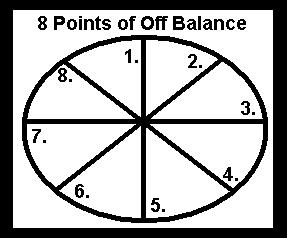
Pushing or pulling: pushing or pulling will move someone out of their base of support but you need to know which way to push or pull. This requires some knowledge of the “eight points of off balance” which relates to stances. Look at this diagram:


As a point of principle your off-balance point is generally perpendicular to the plane of your stance. So if your feet are positioned on points 8 and 4 on the diagram (this could be a left foot zenkutsu dachi (weight forward) or kokutsu dachi (weight back) and facing point 1 or even a shiko dachi if you were facing towards point 2 or 6) then you will be off-balance if pushed or pulled in the direction of 2 -6 or 6-2

So for example, if you are grabbed by the wrist by someone standing in front of you in a natural stance i.e with feet positioned on 3 and 7 then you only need to trap their hand and step backward to position 5 to unbalance them.  In order that you don’t unbalance yourself you need to use fairly strong, deep stances to ensure your centre of gravity remains low, your base of support is wide and your spine remains vertical. I never understand why people argue that stances in karate are no good and only useful for building leg strength – good strong stances are great for pulling people off balance. Of course taking just one step back many not be sufficient and you may need to take two or three long low steps backwards to pull your opponent over.

Reducing the opponent’s base of support: you can reduce the opponent’s base of support by taking one (or both) leg away e.g. with an ashi barai (foot sweep) technique or just a plain and simple ‘trip’. You may want to follow this up with a push, pull or even a throw.

Raising the opponent’s centre of gravity:

If a low centre of gravity assists with balance then a high centre of gravity will help reduce it. Getting your opponent up on their toes will make them seem lighter and easier to displace. Getting a good arm/elbow lock on can often get them on their toes. They won’t drop their weight back down to compensate because that will tighten the lock and cause more pain. You will now have them controlled and not fully balanced making it easier for you to apply your next technique – this may be a sweep or throw or just maintaining the restraint to march them off (always walk backwards with your restrained ‘prisoner’, I am told on good authority, it is harder for them to resist).

Disrupt your opponent’s vertical alignment:

Getting your opponent’s head and spine out of a vertical alignment will disrupt balance because it stops them from pushing their centre of gravity in a downwards direction. It is also very disorientating because it upsets the ‘balance sensors’ i.e. the eyes can no longer maintain a horizontal plane, the cochlear fluid in the ears may start to swirl and cause dizziness and the proprioceptors may have a hard time working out the body’s position in relation to the ground.

Techniques to disrupt vertical alignment include pushing the forehead backwards. This is especially effective if the other hand is placed at the lower end of the spine to create a push/pull effect. Alternatively you can twist the opponent pushing on one shoulder whilst pulling on their opposite hip.
These are just a few techniques you can use to disrupt balance, I’m sure that with a bit of creativity you can think of more!

Of course your opponent will instinctively try to correct their balance once they feel it starting to go. They will do this in predictable ways – the same ways you will try to do it. If you are pulled forward you will put a foot out to steady yourself. You will put your foot out in the direction you perceive yourself to be falling. If you are falling backwards you will try to step backwards. To stop your opponent from trying to correct their balance you need to stop them from putting their foot in that optimal position for regaining balance – you do this by making sure your foot is there first, forcing them to put their foot in a sub-optimal position and thus still being off-balance. 

To conclude: 

Unbalancing your opponent is a good tactical self-defence principle. It enables you to disrupt your opponent’s attack and gives you an opportunity to gain control of the situation. Good unbalancing is both a science and an art form. It requires some serious study into the physiological principles of balance and an exploration of ways of disrupting those principles. In any martial arts class it is worth spending time with a partner just manipulating and observing the effects of balance point disruption. Experiment with this in isolation as well as incorporating these unbalancing principles into various strategies and techniques and notice how much more quickly you are able to disrupt and control your opponent.


Sue is the Blog-Editor-In-Chief for Martial News. You can contact her at sue.wharton@martialnews.co.uk
Sue also writes a personal blog called My Journey to Black Belt


Thursday, 3 May 2012

Where does YOUR karate come from?


Don’t worry this isn’t going to be yet another treatise on the history of karate – we all know karate comes from Okinawa…

What I mean is where does YOUR karate come from in YOU?

You may be aware of the phrase Shin Gi Tai. This goes a long way to explaining where your karate comes from but in my opinion it misses one important ingredient. Before I reveal what that is lets explain what these terms mean:

Tai: This means the body (e.g. tai sabaki – body movement). It refers to the fact that to do karate well you must have a fit, healthy body that is flexible, coordinated and strong. Our body must be able to endure physical contact with another and react quickly to changing situations. We achieve this kind of body through hard repetitive training of the basics of our art as well as our own supplementary training.

Shin: This means the mind (e.g mushin – no mind; shoshin – beginner’s mind, seishin – positive mind, zanshin – an aware mind). It refers to the need to cultivate the correct mental skills to be a good karateka such as developing a clear and uncluttered mind that is fully focused on the task in hand whilst still maintaining a peripheral awareness of what is happening around. It also refers to developing a positive, confident spirit, one that will persevere with determination to achieve one’s goals.

Gi: This refers to technique. It’s no good cultivating the perfect body and mind if you don’t know how to do any karate! Obviously you need to learn and practice a range of karate techniques too.

We generally develop shin gi tai in parallel, improving in each one as we progress through training, so you might consider that your karate comes from your body, mind and good technique all combining together in a coordinated fashion . It’s a very holistic approach – the end result being greater than the sum of the parts; but for me there is an ingredient missing here…

I would argue that karate really comes from the heart. The Japanese word for this is kokora. The heart is the seat of passion, compassion, conviction not to mention courage. We feel all these things in our hearts and it is these things that drive us to be good karateka. We feel our karate in our hearts; it virtually bursts out of us if we are doing it well.

If you look around the students in your dojo you can see who has the heart for it and who doesn’t. Some will be sweating with the effort, appear to be concentrating, even have reasonable technique but their face tells you they have no heart for it, their faces expressionless and bored. Others may still be out of shape, getting a little confused with the technique but the look of joy and animation on their faces as they persist in trying to improve tell you they have heart.

Having the heart for karate may save you one day – if you lose heart you will lose the fight.

So where does YOUR karate come from – is it the heart?


Sue is the Blog-Editor-In-Chief for Martial News. You can contact her at sue.wharton@martialnews.co.uk Sue also writes a personal blog called My Journey to Black Belt
Wednesday, 28 March 2012

A beginner's mindset....

Yesterday I read a comment left on one of my recent posts on my personal blog (My Journey to Black Belt), Joint locking – how useful is it really? by an anonymous commenter, which accused me of having a ‘beginner’s mindset’. I say accused because the tone on the comment was clearly an attempt to patronise or insult me.

This is the offending part of the comment :

“…….I find this discussion rather sterile and representative of a beginner's mindset: take this question to your sensei, if he/she can't show it follow my previous advice. 

I don't mean to be condescending but from what you've written it's clear your understanding of this subject is rather limited:
 …….”

(This is just an excerpt from the comment; visit the post to read the entire comment)

At first I was a little taken back by the comment but after thinking about it for a few minutes I realised that being told I had a beginner’s mindset was in fact very high praise! It meant that I was open-minded, my cup isn’t yet full, I can still learn new things, gain new understanding….

Actually I don’t thing Anonymous meant that at all but he/she is wrong in thinking that a beginner’s mindset is a bad thing in a martial artist.

Maintaining a beginner’s mindset is a Zen concept called shoshin.  It refers to having an attitude of openness, eagerness, and lack of preconceptions when studying a subject, even when studying at an advanced level, just as a beginner in that subject would.

Zen teacher, Shunryu Suzuki said, “In the beginner's mind there are many possibilities, in the expert's mind there are few.”

There are clearly many advantages to maintaining a beginner’s mind:  curiosity, openness, enthusiasm, creativity…… Unfortunately, the person with the ‘expert mind’ becomes the opposite of this:  un-inquiring, closed mined, stilted, un-creative – arrogant even.

Clearly the concept of shoshin has spread far and wide. A quick google on ‘beginner’s mindset’ found articles promoting the concept on a range of activities including swimming, software production, yoga and advertising. Each of the experts in these fields was promoting the idea of maintaining a beginner’s mindset to improve one’s ability in the respective field of practice.

All I can say to Anonymous is thank you for noticing that I have a beginner’s mindset. Clearly I am still on the right path in my martial arts studies.

Do you have a beginner’s mindset?


Sue is the Blog-Editor-In-Chief for Martial News. You can contact her at sue.wharton@martialnews.co.uk 
Sue also writes a personal blog called My Journey to Black Belt

Friday, 2 March 2012

Age and martial arts

I was recently browsing around the Download Karate.com website and came across a video looking at students from different clubs testing for their shodan rank. The point of the video was to give you a flavour of what standard should be expected for a 1st kyu grade testing for shodan.

Here is the video:


I found the standard of the students good but also in line with what I would expect someone testing for shodan to be like. However, I was more interested in Jason Armstrong’s comments towards the end of the video where he states that in their organisation they have a different shodan curriculum for people over the age of 40 than for those under 40 (the students seen in the video are testing with the under 40 curriculum).

My first reaction to this was Hey, we’re not past it yet you know - no need to slow it down for us! Then I was reminded of my current persistent shoulder injury and the excessive aching I often get after training and realised that was my ego talking!

After thinking about it a bit more I realised that having a slightly modified syllabus for middle aged and older people is probably not a bad idea. In Jason Armstrong’s organisation the under 40 curriculum focus’s a lot more on ‘modern’ karate i.e point sparring, kata performance etc and slightly less on self-defence and bunkai. The over 40’s curriculum is balanced the other way around with more emphasis on traditional karate, self-defence and bunkai. 

I think this probably works well. In my experience younger people are better at point sparring, can get their kicks up higher and faster and often look better in the performance aspects of kata . They are often more interested in the competitive aspects of modern karate than older people.

I also think (and I’m generalising here) that older people are more interested in the technical aspects of karate and have more patience to learn and experiment with them. They tend to want to discuss technical details more and often read to assist their learning.  Of course, many younger people are like this to and many older people still like competition but as a rule of thumb  I think that younger people get more excited by the thought of sparring and putting on a good kata performance and older people get more excited about delving more deeply into bunkai and self-defence issues – it’s certainly true for me. 

I think that having different but overlapping curriculum for younger and older people can help them to play to their strengths and interests whilst still working on their weaknesses. I know some people might view this as a bit of a cop out for older people but is it reasonable to expect someone of 50 to be able to do the same physical activities as someone of 20? Anybody over the age of 40 or 50 will know that their body is not as flexible or capable as it might have been when they were younger. However, a young person cannot possible know what their body will feel like when they are older and so are in a more difficult position to make a judgement on this.

Some people would argue that everyone in a club testing for shodan should be tested on exactly the same material because that is fairer and ensures everyone achieves the same standard. This would be fair if the curriculum represents all aspects of karate equally so that older people can score more highly in areas that they are better in and younger people can score more highly in areas that suit them better. However, if the curriculum is biased towards areas that favour one age group then it isn’t fairer.

I know that this thinking may be a bit controversial. What do you think? Does your club have different curricular for younger and older people (not including children’s curriculum)?


Sue is the Blog-Editor-In-Chief for Martial News. You can contact her at sue.wharton@martialnews.co.uk
Sue also writes a personal blog called My Journey to Black Belt

Monday, 30 January 2012

Kiai – something you hear or see ?

Isn’t it strange how you think you know what something is only to realise years later that your understanding was a little superficial? There’s always more layers to everything isn’t there?

Kiai is a case in point. Back in April 2009 I wrote a post called Power of the kiai in which I quoted a definition of kiai as 'a projection of sound fused with energy or spirit'. Other people define it as a‘spirit shout’. Back then I just thought kiai was all about the shouting, a sharp exhalation of breath to tense the muscles and make your punches harder.

I understand kiai a little differently now. It isn’t a ‘thing’ that we do, i.e we don’t do a kiai as we punch; it isn’t merely a stylistic affectation for good effect. It is a part of us, something that we develop through hard training. We demonstrate kiai in the way we execute our techniques irrespective of whether we make a noise or not. Kiai is something that we see when we watch a student (if they have it) and not just something that we hear.

Many people will make a lot of noise but have no kiai, others will train silently but you will be left in no doubt that they have kiai in bucket loads. Kiai is also something you will feel in yourself when you have it.

So what am I talking about now?

According to Iain Abernethy in his book Bunkai-Jutsu, kiai is “…the convergence of all your energies at a single instant that ensure your goal is attainted….It is often accompanied by a loud noise, but simply shouting is not kiai.” He compares kiai to a loud explosion: “An explosion will make a loud noise, but a loud noise is not an explosion.”

The noise of kiai is simply the result of the outburst of energy as you deliver power to your target. It isn’t contrived. The important thing is the explosion of power to the target not the noise, though a scary noise might be useful too.

Kiai is something that starts off internal and becomes external as you execute a move. It is an outpouring of focus and concentration, grit and determination and a will to be perfect and precise. It’s as if you’ve charged up a battery inside of you and it’s discharging at full power. 

I bet you’ve felt it: you’re practising a kata or standing in front of a punching pad/bag; you know an explosive burst is needed; you breathe in through the nose in preparation; you feel energised; then,wham – you execute that explosive movement with a sharp exhalation. You were blind to everything except the target; no other thoughts were in your mind; you wanted it to be the best most perfect move you’ve ever done – you had kiai…you were an explosion.

How do you develop kiai? According to Forrest Morgan in ‘Living the Martial Way’, you need to do five things: “find kokoro; practice haragei; develop kokyu chikara; apply kime and practice kata with utmost seriousness.”

Kokoro means ‘heart’, ‘mind’ or ‘essence’.  It’s often interpreted as never accepting defeat, finding that indomitable spirit within – having the grit and determination to succeed.  It’s about putting ‘heart and soul’ into your training.

Haragei. Hara = centre, gei = cultivation of, so haragei is the “cultivation of the centre of the self”. In other words, it is developing a proper awareness of where your centre of gravity is (2-3 inches below your navel) and knowing how to use it to good effect. To generate good technique you need to be rooted but agile. To generate kiai you need good technique. All techniques in karate require you to be aware of your hara.

Kokyu chikara means ‘breath power’. It’s about coordinating your breathing with the preparation and execution of techniques to maximise power.

Kime is about focus; physical, mental and spiritual focus. You focus your mind, body and intent on achieving your objective. You remain in the moment, you block out all other thoughts; you identify your target and aim precisely at it, focusing all your energy at one point.

So, to develop kiai we must put ‘heart and soul’ into our techniques, understand how to use the hara effectively, coordinate our breathing correctly and focus completely on our objective.

How do we train to develop kiai? Well, most people, including me, will say kata, kata, kata! Through a serious practice of kata we can learn to understand and develop the necessary attributes that lead to kiai.Warning! It takes year of training to achieve kiai..

Next time you are watching students train look for their kiai as well as listen….

Has your understanding of something changed as you've progressed through your training?


Sue is the Blog-Editor-In-Chief for Martial News. You can contact her at sue.wharton@martialnews.co.uk Sue also writes a personal blog called My Journey to Black Belt